Social media has become essential to modern business marketing. Platforms such as Instagram, Facebook, LinkedIn, and YouTube help businesses connect with potential customers, promote their services, and build a recognizable online presence. However, simply creating social media accounts and posting content occasionally may not deliver the results a business expects.
An effective social media marketing plan gives businesses a structured way to connect with the right audience, choose the most relevant channels, and share engaging content. It also helps them track campaign results, promote their offerings with purpose, and develop stronger connections with potential and existing customers.
Whether you’re running a growing business, launching a new venture, or promoting brands online, a well-organized social media plan can help you achieve better marketing results. Instead of publishing random posts, you can focus on content that supports your business objectives and encourages people to engage with your brand.
In this guide, you will discover what a social media marketing strategy is, why it matters, how to create one step by step, and how to measure its success.
What Is a Social Media Marketing Strategy?
A social media marketing strategy is a structured plan for using social media platforms to achieve specific business goals. It outlines the audience you want to reach, the content you will create, the platforms you will use, and the methods you will follow to evaluate results.
An effective strategy generally includes clear objectives, audience research, content planning, platform selection, brand messaging, audience engagement, and performance measurement.
For example, a skincare business may use Instagram to share skincare tips, product demonstrations, customer testimonials, and educational videos. It can also use paid advertising to reach people interested in skincare products and direct them to its website.
The main difference between a strategy and random posting is purpose. Every social media activity should contribute to a specific objective, such as increasing brand awareness, generating leads, attracting website visitors, or improving sales.
Why Businesses Need a Clear Social Media Marketing Plan
A well-defined social media strategy allows businesses to manage their marketing efforts wisely while gaining a better understanding of customer needs and communicating with their audience more effectively.

1. Build Brand Awareness
Publishing content regularly across social media platforms helps audiences recognize your brand and become more familiar with what your business offers. Using recognizable visuals, relevant messages, and a consistent brand voice makes it easier for customers to identify your brand across different platforms.
2. Reaches the Right Audience
Understanding your target audience allows you to create content that matches their interests, preferences, and needs. This helps your business connect with people who are more likely to be interested in your products or services.
3. Increases Customer Engagement
Social media provides opportunities to communicate directly with customers. Responding to comments, answering questions, and participating in conversations can help build stronger relationships.
4. Drives Website Traffic
Useful posts can encourage people to visit your website to explore your services, read blog articles, or learn more about your products. Clear calls to action help guide interested users towards the next step.
5. Supports Lead Generation and Sales
Social media campaigns can introduce potential customers to your offerings and encourage them to make enquiries or purchases. A suitable combination of educational content, product information, and advertising can support the customer journey.
6. Builds Trust and Loyalty
Sharing helpful information, responding professionally to feedback, and presenting genuine customer experiences can strengthen your brand’s credibility. Staying connected with customers through regular interactions helps strengthen their relationship with your business over time.
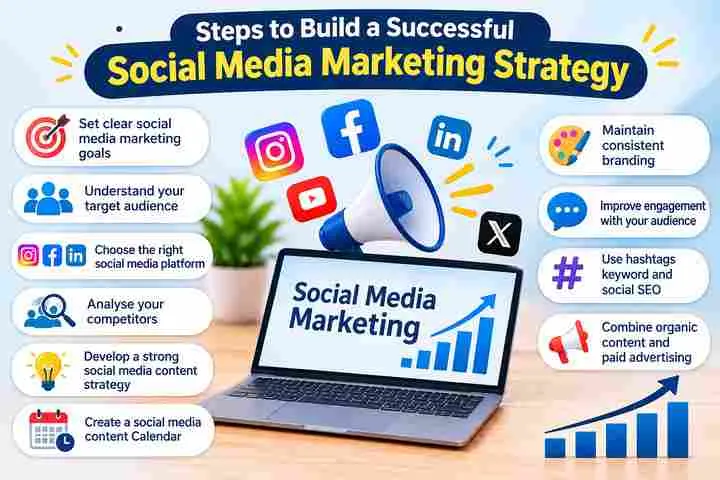
Steps to Build a Successful Social Media Marketing Strategy
Creating a successful social media plan involves understanding your audience, setting clear objectives, and reviewing your progress regularly. These practical steps will help you build an approach that aligns with your business needs and marketing goals.
1. Set Clear Social Media Marketing Goals
Start by deciding what you want to achieve through social media. Your goals should support your wider business objectives.
Common goals include:
- Increasing brand awareness
- Growing relevant followers
- Improving audience engagement
- Driving website traffic
- Generating qualified leads
- Increasing product sales
- Improving customer communication
Use the SMART framework to make your goals specific, measurable, achievable, relevant, and time-bound.
For example, instead of setting a vague goal such as increasing engagement, aim to improve your average engagement rate by 15% within three months.
Clear goals help you choose suitable content formats, allocate your budget, and measure progress. They also prevent you from focusing on metrics that do not contribute directly to your business objectives.
2. Understand Your Target Audience
Knowing your audience is essential for creating relevant social media content. Different customers have different interests, challenges, purchasing habits, and platform preferences.
Research the following factors:
- Age group and location
- Interests and lifestyle
- Problems your products or services solve
- Preferred social media platforms
- Frequently asked questions
- Content formats they enjoy
You can collect this information through customer feedback, surveys, website analytics, social media insights, and competitor research.
For example, a digital marketing agency targeting small business owners might publish SEO tips, website improvement guides, advertising advice, and practical marketing tutorials.
Understanding your audience helps you choose appropriate topics, language, and content formats. When your content addresses real customer needs, it becomes more useful and relevant.
3. Choose the Right Social Media Platforms
Every social media platform serves different purposes. Rather than trying to maintain an active presence everywhere, select platforms that match your audience and marketing objectives.

- Instagram: Suitable for visual content, Reels, product demonstrations, brand storytelling, and community engagement.
- Facebook: Useful for local business promotion, community building, customer communication, and targeted advertising.
- LinkedIn: Ideal for professional networking, B2B marketing, industry insights, and business-related content.
- YouTube: Effective for tutorials, product reviews, demonstrations, educational videos, and long-form content.
- TikTok: Useful for short-form videos, creative storytelling, and reaching audiences interested in relevant trends.
- Pinterest: Suitable for visually searchable content related to fashion, design, home decor, recipes, and similar interests.
Before choosing a platform, consider where your audience spends time and what type of content your business can produce consistently.
Start with one or two suitable platforms, monitor their performance, and expand your presence when you have sufficient time and resources.
4. Analyze Your Competitors
Competitor analysis helps you understand how similar businesses communicate with their audiences. Reviewing their social media activity can reveal content opportunities and areas where your brand can stand out.
Observe their posting frequency, content formats, visual identity, messaging, audience interactions, and promotional campaigns.
Pay attention to the topics that generate meaningful engagement. These may indicate questions or interests that are relevant to your own audience.
For example, if competitors mainly publish promotional posts, your business could create educational videos, practical guides, or behind-the-scenes content that provides additional value.
The objective is not to copy competitors. Instead, use your observations to identify gaps, improve your content, and develop a distinctive brand identity.
5. Develop a Strong Social Media Content Strategy
Content is central to every successful social media marketing strategy. Your posts should provide value, communicate your brand message, and encourage meaningful interactions.
Consider using different content categories.
- Educational content: Share tutorials, practical tips, industry advice, and answers to common questions.
- Entertaining content: Create relatable videos, appropriate humour, and engaging stories.
- Promotional content: Highlight products, explain services, announce offers, and share new launches.
- Behind-the-scenes content: Show your team, work process, product preparation, or business journey.
- Customer-focused content: Publish authentic reviews, testimonials, and customer experiences with permission.
- Interactive content: Use polls, quizzes, questions, and discussion prompts to encourage participation.
For example, a skincare brand could share a morning skincare routine, explain product ingredients, demonstrate how to apply a product, and feature genuine customer feedback.
Maintain a balance between educational, engaging, and promotional posts. Providing useful information alongside product promotions gives people more reasons to follow your brand.
6. Create a Social Media Content Calendar
A content calendar helps you organize your posts and maintain a consistent publishing schedule. Planning content also reduces last-minute work and makes campaigns easier to manage.
Your calendar can include publishing dates, platforms, topics, captions, content formats, visual requirements, and campaign objectives.
Here is a sample weekly content schedule:
| Day | Content Type | Main Goal |
| Monday | Educational carousel | Share useful information |
| Tuesday | Short-form video | Increase discovery |
| Wednesday | Poll or question | Encourage engagement |
| Thursday | Tips or tutorial | Build credibility |
| Friday | Product or service post | Generate enquiries |
| Saturday | Behind-the-scenes content | Build familiarity |
| Sunday | Community post | Maintain relationships |
This schedule is only an example. Adjust the frequency and formats according to your resources, audience preferences, and performance data.
Consistency is more important than publishing a large number of low-quality posts. Focus on creating valuable content that supports your goals.
7. Maintain Consistent Branding
Consistent branding helps customers recognize your business and understand what it represents. Your social media profiles should communicate a clear and professional identity.
Maintain consistency in your logo, brand colors, typography, imagery, tone of voice, and messaging.
For example, a premium skincare brand may use minimal designs, natural lighting, clean layouts, and sophisticated language. A business targeting younger audiences may prefer more energetic visuals and a conversational tone.
Consistency does not mean every post must look identical. You can experiment with different content formats while maintaining recognizable brand elements.
A clear brand identity creates a more professional online presence and helps your business stand apart from competitors.
8. Improve Engagement With Your Audience
Social media marketing is not just about publishing posts. It also involves developing relationships with people who interact with your business.
Respond to comments and messages, answer customer questions, acknowledge feedback, and encourage discussions. Interactive features such as polls, question stickers, and quizzes can also help you understand your audience better.
When customers raise concerns, respond politely and provide useful information. Address individual or sensitive customer issues privately when appropriate.
You can also ask followers what topics they want to learn about or which products interest them most. Their responses may provide useful ideas for future content.
Focus on meaningful engagement rather than likes alone. Relevant comments, genuine conversations, shares, and customer enquiries can provide valuable insights into your audience’s interests.
9. Use Hashtags, Keywords, and Social SEO
Social media platforms increasingly help users discover content through search features. Optimizing your profiles and posts can make it easier for people to find relevant information about your business.
Include relevant keywords naturally in profile descriptions, captions, video titles, and other searchable fields where appropriate.
For example, a digital marketing agency may use phrases such as “SEO services,” “social media marketing,” and “digital marketing tips” in relevant posts.
Use hashtags that accurately describe your content and industry. Avoid adding unrelated hashtags simply to attract attention.
Other useful practices include writing descriptive captions, using clear video titles, adding image alt text where supported, and keeping business contact information updated.
For local businesses, including accurate location information can also help potential customers understand where services are available.
These practices can improve content discoverability, although rankings and reach depend on each platform’s systems and audience behaviour.
10. Combine Organic Content and Paid Advertising
Organic social media marketing involves publishing content and building relationships without paying for distribution. Paid social media advertising uses a budget to reach selected audiences through sponsored campaigns.
Both approaches can support business growth.
Organic content helps businesses share knowledge, maintain communication, and develop a community. Paid advertising can help promote specific offers, increase campaign reach, and attract potential customers.
Before launching an advertisement, define your campaign objective, audience, budget, creative format, and desired action.
For example, a local business might advertise its services to people in its service area. An online store might promote a product to relevant audiences and direct them to a dedicated product page.
Test different visuals, messages, and audience groups when possible. Monitor the results and adjust your campaigns according to performance.
Paid advertising should support a clear marketing plan rather than replace useful content and customer engagement.
11. Track Performance and Improve Your Strategy
Measuring performance helps you understand whether your social media activities are contributing to your goals.
Important metrics include:
- Reach: The number of unique accounts that see your content.
- Impressions: The total number of times your content is displayed.
- Engagement rate: Engagement measured against a defined audience or reach metric.
- Follower growth: Changes in your audience size over time.
- Link clicks: Clicks on links shared in your posts or advertisements.
- Website traffic: Visits arriving from social media.
- Leads: Enquiries and potential customers generated.
- Conversions: Completed actions, such as purchases or form submissions.
- Return on ad spend: Revenue attributed to advertising compared with advertising expenditure.
Use platform analytics and website measurement tools to monitor these indicators.
For example, if educational videos consistently generate more website visits than promotional images, consider producing more videos that address relevant customer questions.
If a campaign receives clicks but generates few enquiries, review the landing page, audience targeting, offer, and call to action.
Evaluate performance regularly and make changes based on meaningful trends rather than the results of a single post.
Common Social Media Marketing Strategy Mistakes to Avoid
Even businesses with an active social media presence can make mistakes that limit their results.
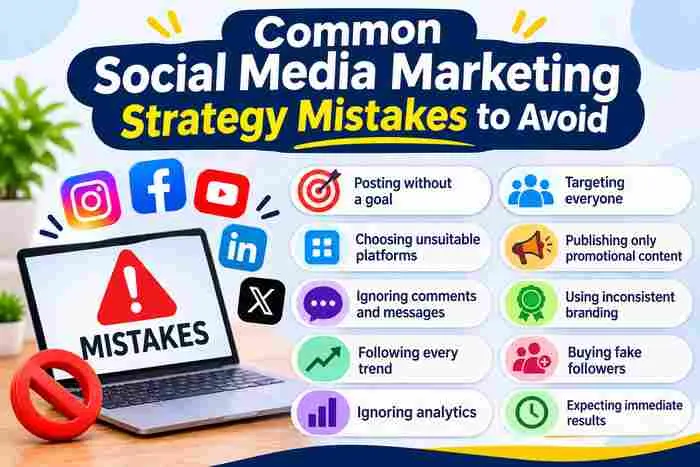
- Posting without a goal: Decide what each campaign or major content activity should achieve.
- Targeting everyone: Identify the people most likely to benefit from your products or services.
- Choosing unsuitable platforms: Focus on channels that match your audience and business objectives.
- Publishing only promotional content: Balance sales messages with educational, entertaining, and useful posts.
- Ignoring comments and messages: Respond consistently to improve the customer experience.
- Using inconsistent branding: Maintain recognizable visuals and messaging across platforms.
- Following every trend: Participate only when a trend is relevant to your brand and audience.
- Buying fake followers: Build a genuine audience rather than relying on artificial engagement.
- Ignoring analytics: Use performance data to identify successful activities and areas for improvement.
- Expecting immediate results: Building brand awareness and customer trust takes consistent effort and time.
Avoiding these mistakes can help businesses develop a more focused and sustainable social media presence.
How to Measure the Success of Your Social Media Marketing Strategy
The right performance indicators depend on what your business wants to achieve. Follower growth may help indicate audience development, but it does not automatically demonstrate that your marketing is generating leads or sales.
Choose key performance indicators (KPIs) that match your goals.
| Goal | Metrics to Track |
| Brand awareness | Reach, impressions, audience growth |
| Engagement | Comments, shares, saves, engagement rate |
| Website traffic | Link clicks, website sessions |
| Lead generation | Qualified enquiries, form submissions |
| Sales | Purchases, conversion rate, attributed revenue |
| Advertising efficiency | Cost per lead, cost per conversion, ROAS |
For example, if your objective is to generate enquiries for a digital marketing agency, measure how many qualified leads come from social media and how many become customers.
Establish a baseline before making major changes. Review campaign results regularly and compare performance over time.
Use the insights to improve your content topics, posting schedule, platform selection, and advertising approach. A strategy that evolves with audience needs and business goals is more useful than a plan that never changes.
Conclusion
A well-planned social media marketing strategy helps businesses build brand awareness, reach the right audience, improve customer engagement, and support long-term growth. By setting clear goals, understanding customer needs, choosing suitable platforms, and publishing valuable content, you can make your social media efforts more purposeful.
Consistent branding, meaningful conversations, relevant keywords, and regular performance tracking also help you identify opportunities for improvement. Remember, social media success isn’t just about gaining followers or posting more. It is about connecting with the right people and encouraging actions that support your business objectives.
Start by reviewing your current social media presence, identifying areas for improvement, and creating a realistic content calendar. Track your results and adjust your approach as you learn more about your audience.
With consistency, useful content, and a clear plan, your business can strengthen its online presence and use social media marketing more effectively.